
Primary Curriculum
In the Primary Phase at Bradley Stoke Community School we follow A Curious Curriculum. This was designed and built in collaboration with teachers across the Olympus Academy Trust. We ensure excellence in all subjects across the curriculum and teach through themes to enable children to consider an intellectual concept and answer enquiry questions. Our teachers are imaginative in their planning and engage with current pedagogy to ensure high outcomes for all children.
Curriculum Principles

Our Curriculum Themes

About Our Curious Curriculum
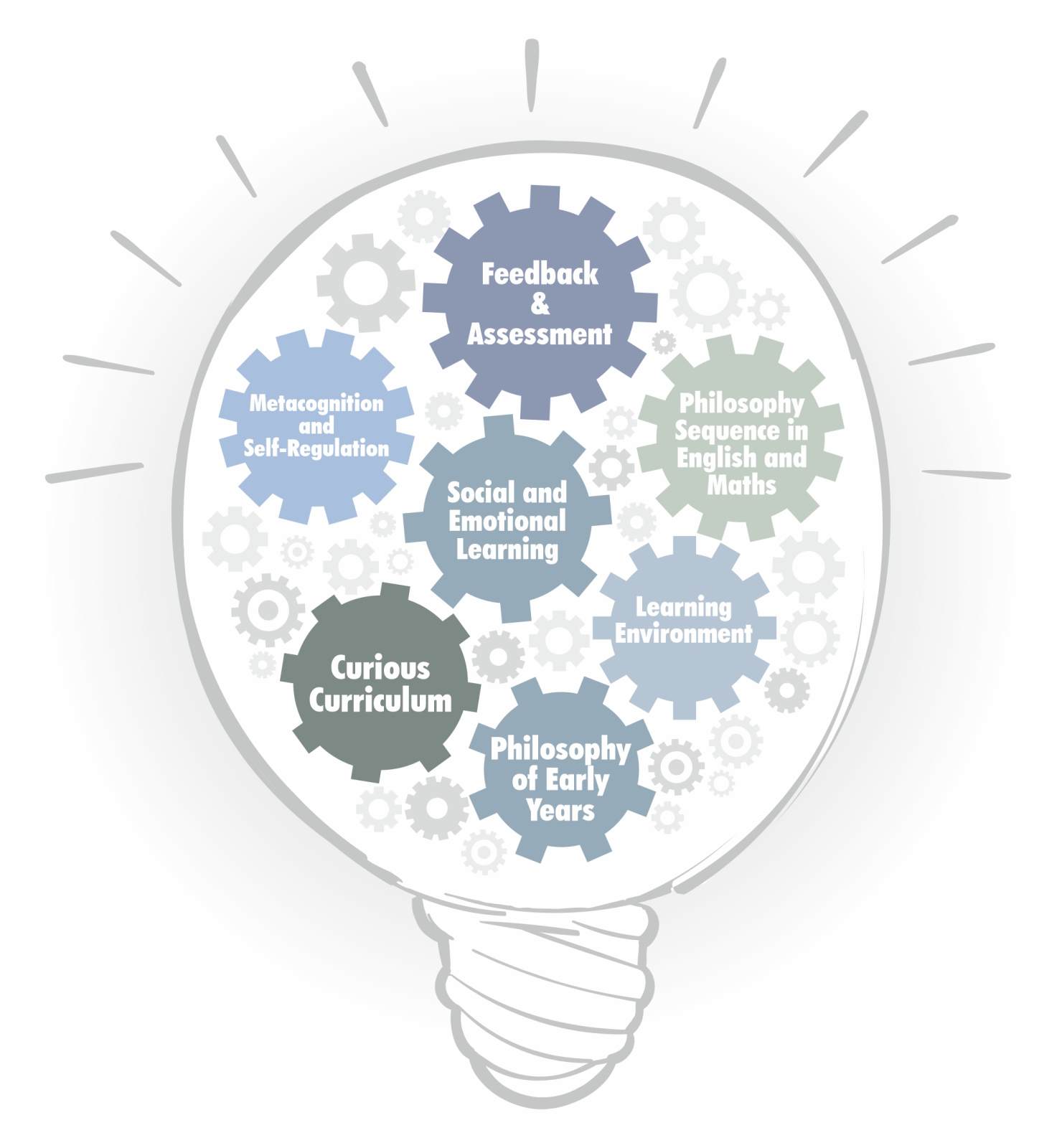
As a school in The Olympus Academy Trust, you can be assured that our wider curious curriculum model covers all aspects of a broad and balanced curriculum that will develop well-rounded learners. It concentrates on the axis where the curriculum and pedagogy meet, making an exciting and innovative way to look at not only what we teach but also how we teach our primary curriculum. The Trust believes that these 6 elements are at the heart of an excellent primary experience. Teachers will be expected to understand, develop and deliver on each of these 6 areas;
- Learning environment
- The English and Maths learning sequence
- Metacognition and self-regulation
- Our curious curriculum
- Our emotionally literate curriculum
- High aspirations and the importance of feedback and assessment
-
"The curriculum can look good on paper, but it is when it meets the learner that matters most. It is the skill of the teacher in bringing it alive that determines whether the learner makes progress or not. This is why the link between curriculum and pedagogy needs to be strong at every point in the chain from planning to assessment"
Professor Mick Waters
Our aims
- We will set high expectations and provide opportunities for all learners to achieve, responding to any learning needs.
- We will offer learning experiences and environments that inspire learners to question the world around them, develop their ideas and grow as lifelong learners.
- We commit to providing consistently high quality education based on current academic research and pedagogical principles.
- Through a holistic approach we will ensure the development of our learners’ physical, social and emotional well-being. This will support their resilience and future life chances.
Pedagogical Principles
- We will develop local/ national and global knowledge and understanding by providing enriching experiences, developing global citizenship, celebrating diversity and creating cultural capital.
- We will be proactive in removing barriers to learning through; early identification, effective intervention improvement through partnership and raising aspirations.
- We will provide a rich multi-sensory environment: that promotes, celebrates and provokes learning and reflects the importance of aesthetics and beauty.
Our Curious Curriculum
The Olympus Academy Trust Curious Curriculum was designed in conjunction with representatives from all of the Schools in the Academy Trust. The group was facilitated by Professor Mick Waters and was part of a two-year project with particular emphasis on the importance of consistency in the journey for learners between years 5-8.
Olympus believes that a learner’s experience in school should ensure not only the knowledge needed to access academic success, but also the careful development and progression of skills in discrete subject areas. The Olympus Curious Curriculum embeds a concept driven approach that incorporates both knowledge and skills in an enquiry-led thematic curriculum that is embedded in application and context. A great curriculum will be rooted in its own locality and context and will meet the needs of its own learners, whilst exposing them to the national and global requirements and expectations.
Our curious curriculum has been carefully designed to engage learners as active participants in their learning journey. We believe that learners are at their most successful when their imagination is stimulated, their curiosity is heightened and their learning makes links to their lives and the wider world. Our curious curriculum is a framework that develops creativity, critical thinking and discovery whilst ensuring a clear focus on the intellectual concept that is being taught and the knowledge needed to understand said concept. In teaching our curious curriculum, teachers will need to draw upon a wide repertoire of teaching styles. It will be essential that teachers understand the best way for learners to acquire certain aspects of the curriculum.
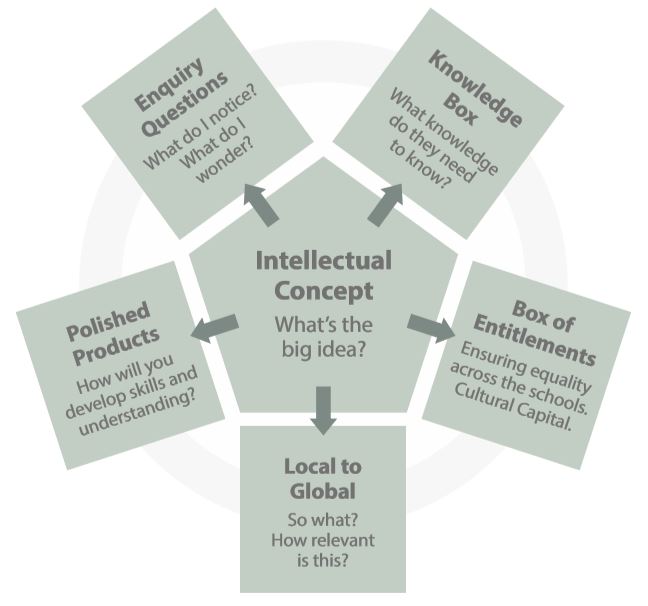
An Olympus Theme consists of:
An Intellectual Concept:
What do you want the learner to understand by the end of this theme? What wider concept or big idea do you hope that they will have understood, using the knowledge and skills taught over this period? The intellectual concept will be an understanding of an idea that has created change or continuity, has resulted in a consequence or significance, and is set in context and chronology. The concept cannot be understood without an essential grounding and understanding of specific knowledge, particular vocabulary and a foundation of understanding regarding context and relevance.
Through the eyes of the child.
‘Let me tell you about the big idea…This is all about…’
Knowledge Box:
What knowledge do the learners need to know in order to understand the intellectual concept? What parts of the National Curriculum will you cover in this theme? These are essential pieces of information that a learner must know in order to research a ‘Bigger idea’ or understand the Intellectual Concept in question. These are not just a list of facts that are ‘known’ but not ‘understood’.
Through the eyes of the child.
‘Let me tell you all the things I know that help me understand the big idea…’
Box of Entitlements:
How will you ensure that your learners receive a broad and diverse range of stimuli and experience throughout this theme? How will the sustainable development goals be woven through your planning?
Novel – Linked to English
Connected Biography
English and Maths Integration
Study of an Artist or Artistic Movement
Visit out / Visitor in
Design and make an object
Debate Question
World of work
Outdoors environment
Environment / Book corner / Display
Provocation
Through the eyes of the child. ‘We have done lots of different things to understand this the big idea in this theme. All the experiences have taught me facts and made me wonder and made me realise…’
Enquiry Questions:
An enquiry question is one that will encourage the learner to wonder and notice. It will capture the interest and imagination of your learners and will be open to research. A good enquiry question may have multiple possible answers, but will have a clear focus. The question should be reasonable and there should be some credible research available to answer it. The questions will lead to further questions and will develop and explore the thinking, concepts and knowledge.
Through the eyes of a child.
‘The question I am trying to answer is complicated. All the things I know are making me realise that this is making me wonder…a lot.’
Polished Products:
What skills will the teacher do to support the learner to develop over this theme, in order that they may produce an extended detailed product to exhibit at the end of Term Exhibition/ Emporium/ Museum?
Through the eyes of the child.
‘I have realised the importance of being organised and practising skills so that the things I have produced are the best they can and people want to look at them, read them…and be amazed at how well I have done to make my learning really interesting to others.’
Knowledge
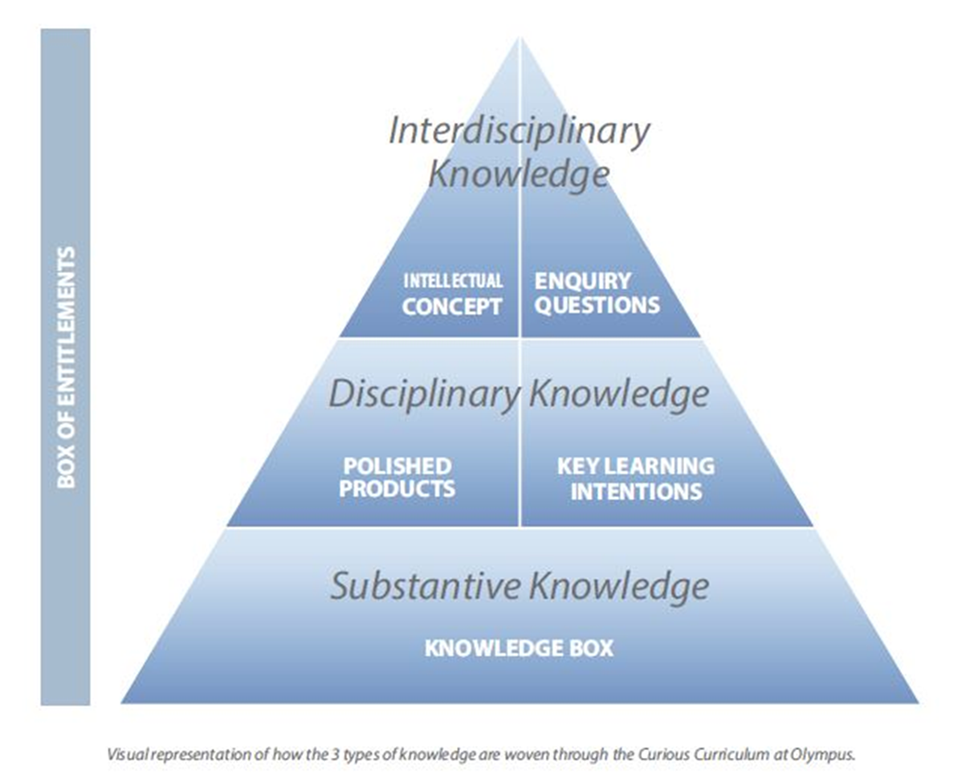
At Olympus we believe in the importance of the development of substantive, disciplinary and interdisciplinary knowledge. We have designed our curriculum to incorporate all 3 types of knowledge;
Substantive Knowledge – this is the knowledge produced by the academic subject. In science, this involves concepts which form the underpinning structure of the subject, e.g. respiration, evolution and the idea of a force.
Disciplinary knowledge – this is the knowledge needed to collect, understand and evaluate scientific evidence for example the concept of being a scientist. It’s the scientific method, i.e. changing one variable whilst keeping everything else the same – and seeing what happens.
Interdisciplinary knowledge – this draws knowledge combining two or more academic disciplines into one activity (e.g., a research project). It is about creating something by thinking across boundaries.
Our Primary Curriculum Maps
Curriculum Subjects
Curious-Curriculum (ID 1045)
-
We are Artists
We are Artists
At BSCS we believe that art is a vital part of our learners’ education and has a significant and valuable role in the taught curriculum. Art education ensures that all learners have the opportunity to explore shape and form, colour and beauty. Art education fosters creative and bright young people who will develop an awareness and appreciation of the aesthetic beauty around us. Learners who will be innovative and creative thinkers who will be problem-solvers, whilst allowing them to use art to develop a sense of belonging and a sense of understanding our global society. Art at BSCS aims to develop critical-thinking skills, creative confidence, hands-on skills, visual literacy, self-esteem, and an appreciation of other cultures.
Our Key Learning Intentions
Our art curriculum will develop learners’ critical abilities and understanding of their own and others’ cultural heritages through studying a diverse range of male and female artists.
Learners will develop their understanding of the visual language of art and through our carefully considered sequences of lessons and experiences they will start to understand the visual elements of art and design (line, tone, texture, colour, pattern, shape, 3D form). Learners will be supported by a curriculum which will enable children to grow and become proficient in the accumulation of skills. They will have the vocabulary to be able to discuss and appreciate the study of significant art pieces and will learn about the history of art and its significance in our global society.

Artist of the Term
-
We are Athletes
We are Athletes
At BSCS we strongly believe in the importance of physical activity, through the forms of structured physical education (PE) and unstructured play opportunities.
Our PE curriculum encourages all learners to be physically active, improving their physical literacy and fundamental movement skills. We want to provide a lasting, sustainable and positive effect on PE and Sport within school and our community.
At Key Stage 1 learners will have access to a broad range of opportunities to extend their agility, balance, coordination, individually and with others during their PE lessons. Through unstructured play and forest school children will be creative and imaginative, develop resilience and build friendships and relationships whilst exploring the world around them.
We want our learners to embrace an active lifestyle by also walking, biking and scooting to school. Being physically active helps to promote physical and emotional health and well-being. Therefore we have used our Sports and PE Premium Funding to provide:
- Specialised Professional Development for teachers across the Trust.
- Strategic leadership of PE and Sports within schools and across the Trust.
- A co-ordinated approach to inter and intra school competition.
- Lunchtime play leader programme and training, that enables all learners to be active all lunchtime and participate in a virtual competition across the Trust.
- Trust-wide gala’s, sports events and athletic meets.
- An elite, talent spotting, signposting programme for those young people with particular talent and promise.
Why is physical education important for all learners at BSCS?
Why does it matter? -
We are Authors
We are Authors
At BSCS, our English curriculum is driven by a range of high-quality texts which seek to challenge and lead to the development of the personal and cultural capital of the children attending our schools.
The texts provide a stimulus for reading, writing and oracy and aim to deliver an opportunity for all to be immersed in a rich vocabulary; one that will support their own development and nurture a genuine love of language and the written word. We believe that all of our children are authors and that the link between reading and writing are heavily entwined. Children are encouraged to question author choices and explore the context in which a text is written, making links with the world around them. Our aim is that English learning is contextualised in children’s experiences and therefore is carefully planned with explicit links to children’s wider learning. We enrich English learning with visits from authors, trips and experiences that will provide a real purpose for reading and writing.
English is taught through a sequential journey that encourages children to read like a writer and write like a reader. The children use a high quality text each term as the basis of their learning. The text is then supplemented with other genre specific texts/extracts dependent upon the expected writing outcome, whether it be to entertain, to inform, to persuade or to discuss.
We plan a unit of work for both reading and writing over a period of three weeks, ensuring that we have a balance of skills and application being taught throughout. In writing, well-planned learning intentions based on formative assessment are mapped out over a complete sequence, enabling learners to move through the gears from novice to expert. We plan a writing sequence backwards, beginning with the end of unit outcome and focusing on the skills that need to be developed in order for children to meet the required expectation.
At BSCS, we use an evidenced-based approach to teaching writing. Using the DfE Writing Framework 2025, our writing curriculum emphasises sequenced teaching, early transcription skills, sentence-level instruction and the importance of spoken language. Our curriculum has been designed with the ambition of improving writing outcomes for all learners.
We recognise that writing is complex, placing heavy demands on pupils' working memory so we work with our teachers and external specialists to carefully sequence planning and reduce cognitive load.
In EYFS and KS1, we focus mainly on transcription to ensure these skills become automatic, freeing memory for composition. We also know that sentence instruction is essential therefore teach grammar with meaning, allowing pupils to practise controlling sentences in context. Using elements of Talk for Writing, we understand that spoken language supports writing and therefore provide opportunities for oral composition and discussion as these skills are as important for writing as they are for reading.
 We will teach learners to speak, listen, read and write fluently so that they can communicate effectively with others. Through reading in particular, learners have a chance to develop culturally, emotionally, intellectually, socially and spiritually. Reading also enables learners to acquire knowledge and to build on what they already know. Being able to write in a range of styles to suit purpose, context and audience, will unlock further opportunities to communicate. All the skills of language are essential to participating fully as a member of society.
Writing expectations
- Learners will produce one non-fiction and one fiction end of unit extended piece of writing termly.
- Further writing opportunities must be given in each stage to allow the application of specific skills to be developed.
- Grammar skills will be taught in context.
- Learners should be exposed to a rich diet of genre-specific supplementary texts within each unit and have the opportunity to explore authorial choices, make comparisons and deepen their own vocabulary.
- Learning intentions will link and model the learning journey clearly for the learners and will separate the skill from the ‘genre vehicle’ being used.
- There will be opportunities for shared writing and modelled writing in each phase.
- Texts will be taught contextually.
- Within each phase, oracy will be developed through book and writer talk, meta-language (structure, grammar, revising and editing) the teaching of specific vocabulary and collaborative learning (discussion and presentation)
- Learners take pride in their presentation using a cursive style for handwriting (from Year 2), valuing the editing and revising process as part of the writing journey.
Olympus Primary Writing Strategy
Key Learning Intentions - English
The Importance of Handwriting
At BSCS, we believe handwriting is a vital foundation for children's success in writing and learning. The DFE Writing Framework 2025 highlights that secure transcription skills such as spelling and handwriting must be taught early and systematically so that they become automatic. This allows pupils to focus on creativity, composition, and meaning in their writing.The new Ofsted Framework 2025 also places strong emphasis on the quality of writing provision, recognising that fluent handwriting underpins confidence, independence and achievement across the curriculum.
From Reception onwards, we embed handwriting into daily practice. Children are taught clear letter formation and joined handwriting through carefully sequenced lessons, with regular opportunities to apply these skills in meaningful writing tasks. For pupils who need extra support, we provide targeted interventions to ensure no child is left behind.
By prioritising handwriting, we are equipping our learners with the foundational skills they need to thrive as writers, communicators and lifelong learners.


-
We are Designers
We are Designers
Why is design and technology important for all learners at BSCS? Why does it matter?
Design and technology is a varied, creative and practical subject. It allows learners to use and develop lifelong skills in a range of different contexts, through a variety of media. Learners are required to think critically and encouraged to ‘think outside the box,’ in order to find solutions to real life problems. It is cross curricular, drawing on, and developing the skills required to be successful in maths, science, computing and art. Design and technology teaches our learners:
- the life skills of planning, design, construction, problem solving and evaluation.to build and apply a repertoire of knowledge, understanding and skills in order to design and make high-quality products for a wide range of users.how to assess risk, take suitable precautions and make adaptations to ensure the safety and welfare of all.how everyday items are designed and produced and why decisions are made about construction techniques and materials.
How does studying design and technology help young people to achieve?
Design and technology teaches children how to research, plan, create, problem solve, adapt, evaluate and think critically. Learners develop essential practical skills that can be used creatively across all subjects throughout the curriculum, and into later life. Design and technology allows learners the opportunity to work independently, and develops the skills of collaboration and team work, transferable across all curriculum areas.
-
We are Digital Leaders
We are Digital Leaders
Why is computing important for all learners at BSCS? Why does it matter?
The core of computing is computer science, in which learners are taught the principles of information and computation, how digital systems work and how to put this knowledge to use through programming. Building on this knowledge and understanding, learners are equipped to use information technology to create a range of content.
Our computing curriculum also ensures that pupils become digitally literate – able to use and express themselves and develop their ideas through information and communication technology – at a suitable level for the future workplace and as active participants in a digital world.
Learners are responsible, competent, confident and creative users of information and communication technology that inspires them to lead change and will enable them to become curious life-long learners.
-
We are Geographers
We are Geographers
Our Key Learning Intentions
-
We are Historians
We are Historians
Our Key Learning Intentions
-
We are Linguists
We are Linguists
-
We are Mathmeticians
We are Mathmeticians
The study of mathematics provides learners with many skills which are transferable across the curriculum and the world around them. Our Maths curriculum supports children to gain a deep long term, secure and adaptable understanding of the subject which enables them to become agile mathematicians. We aim to encourage learners to gain fluency in number and be able to reason and problem solve using a variety of strategies.
Maths enables learners to become confident in sharing their mathematical thinking through oral and written work. Our learners are introduced to a wide range of mathematical vocabulary which enables them to articulate their understanding in a concise and logical manner. Throughout our mathematics curriculum, children are encouraged to develop their mathematical thinking leading them to be able to build upon and challenge the ideas of others. Our curriculum aims to equip learners with the skills, knowledge and understanding needed to be successful in the next stage of their learning. We believe that all children are capable of achieving high standards in mathematics.
Our Curriculum
Our curriculum is driven at Primary by the 2014 National Curriculum for mathematics, the aims of this are to ensure all learners:
-
We are Musicians
We are Musicians
At BSCS we believe that music is a universal language, which is inclusive and accessible for all.
We aim to develop and inspire all learners to be able to perform, compose, listen to, review and evaluate music across a range of genres styles and traditions; through this they develop an understanding and empathy of cultures, context, time and place. They will develop transferable skills such as collaboration, presentation, independence, concentration, and nurturing working memory both in the classroom and beyond.
We aim to do this in a practical and engaging way, with every learner having opportunities to perform, use technology and listen to recorded and live music. Through our music curriculum, all learners will be given a platform to express their creativity and individuality, whilst supporting their confidence, well-being and mindfulness through an expressive output.
We aim for all learners to appreciate and understand the importance of music whilst broadening their horizons.
As part of our Bradley Stoke Ethic of Excellence, we use Kapow Primary Music to support us in providing high quality models and examples. We also use this to ensure our teachers are skilled to provide excellent teaching for our children.
The scheme supports with planning, resources and professional development for our teaching team to ensure high quality music teaching. It also enables us to track and show full coverage of our Key Learning Intentions (KLIs).

We Are Performers
-
We are Scientists
We are Scientists
Our Key Learning Intentions
-
We love Reading
We love Reading
Reading Curriculum
We have used Scarborough’s ‘Reading Rope’ to coordinate the different components of reading and have developed our reading strategy to ensure the different strands of reading are taught explicitly.


Our Reading Strategy
Olympus Trust Reading Strategy
Reception Story Spine
Our Reading Roadmap that supports writing (Year 1 - Year 6)

Our Literacy Spines (Year 1 - Year 6)
Year 1


Year 2


Year 3


Year 4


Year 5


Year 6


Phonics
At BSCS we follow the Sounds Write programme (Copyright © 2020 Sounds Write) and key members of staff complete a 4-day training course. The programme begins with the sounds in the language and moves from the sounds to the written word.
In order for a learner to become a fluent reader, they must be taught all the common ways of representing English speech sounds (phonemes). A systematic approach is required, teaching from simple 1 – sound: 1 – letter correspondences to sounds represented by several different spellings. The order in which the code is presented should correlate with the complexity of the conceptual knowledge required to use it.
Given the fact that speech is uttered one sound at a time, and that written English is a means of recording those sounds via visual symbols that we call spellings/letters, the following skills are essential:
- The skill of blending individual sounds to enable the construction of meaningful words, such as /c/…/a/…/t/…’cat’
- The skill of segmenting individual sounds in speech is vital for both reading and spelling. To read, the reader must segment the sound-spelling correspondences in a word before blending them to make a recognisable word.
Of course, when writing, the same skill of segmenting will also be needed. The learner needs to be able to split the word ‘dog’ into its three component sounds /d/…/o/…/g/ to access the alphabet code and then represent each sound graphemically.
- The skill of manipulating the individual sounds within words to enable one sound to be replaced by another. This skill is essential in order to deal with the problems of decoding that might arise when a spelling represents more than one sound. In the interest of reading quickly and fluently the reader needs to be able to manipulate sounds instantly without having to revisit the cumbersome process of blending the whole word together again from the beginning.
It is important to note that speed and accuracy need to be achieved for all three of the above skills for them to become automatic. Once the process is automatic the reader can then concentrate solely on understanding and extracting information from the text they are reading.
Religious Education (RE)
Why is religious education important for all learners at BSCS? Why does it matter?
The principal aim of religious education at BSCS is to engage learners in a systematic enquiry approach where they can develop an understanding and appreciation of the main religions and worldviews in the local, national and global community. Through our RE curriculum we aim to inspire, challenge and encourage learners, equipping them with the knowledge, skills and understanding to answer challenging questions about the purpose of life, issues of right and wrong and what it means to be human. Finally, we believe a high quality religious education promotes awareness and respect – enabling learners to combat prejudice, and preparing them for adult life, employment and life-long learning.
How does studying religious education help our young people to achieve?
Our religious education curriculum aims to ensure that all pupils:
- Develop knowledge and understanding of the principal religions and world views represented in Great Britain;
- Develop understanding of the ways in which beliefs influence people in their behaviour, practices and in their communities
- Weigh up the value of wisdom from different sources, learn to develop and express their own insights, and to agree or disagree respectfully.
- Recognise the right of people to hold diverse beliefs and values and to develop positive attitudes of respect towards other people;
- Reflect on modern ethical issues form a range of views with the purpose of developing well thought through opinions and attitudes.
- Widen the world view of our catchment areas by developing community cohesion through the study of the place of our multicultural society in the local, national and wider global community.
Our Religious Education Curriculum
At BSCS we use Discovery RE to support our staff and pupils and quality assure our Religious Education curriculum. The scheme supports with planning, resources and professional development for our teaching team to ensure high quality teaching. It also enables us to track and show full coverage of our Key Learning Intentions (KLIs).

Discovery RE
The scheme adopts an enquiry-based approach to teaching and learning. Christianity is taught in every year group, with Christmas and Easter given new treatment each year, developing the learning in a progressive way. Baha’i, Buddhism, Hinduism, Humanism, Islam, Judaism and Sikhism are also covered. Humanist perspectives are added when appropriate in some enquiries in addition to the Introduction to Humanism enquiry.
Each enquiry demands the equivalent of 6 lessons, but teaching time is sometimes blocked to enhance learning. Each enquiry has a learning objective which shows the learning over the enquiry and SMSC (Spiritual, Moral, Social and Cultural) development opportunities are mapped throughout as is each enquiry’s contribution to the British Values agenda.
British Values
At BSCS we believer Religious Education is a key player in engendering knowledge and understanding which can lead to tolerance and respect for others and their beliefs. It does not, however, teach children to passively accept, but rather encourages evaluation and critical thinking, equipping them to consider belief positions they encounter. Discovery RE contributes significantly to the British Values agenda.
Mindfulness
Mindfulness means cultivating a sense of awareness on purpose, in a non-judgemental way in the present moment. At BSCS, our teachers use mindfulness practices to build children’s self-awareness and skills of reflection, thus supporting their RE learning as well as their personal spiritual development. As we use Jigsaw, the mindful approach to PSHE, we also use Calm Me time in RE lessons too.
Managing the right to withdraw
In line with the Education Act, parents have the legal right to withdraw their child from all or part of Religious Education. Any parent wishing to exercise this right should make their request in writing to the Headteacher.The school will respect these decisions and discuss with parents how the withdrawal will be managed to ensure that pupils remain appropriately supervised. All Religious Education teaching is delivered with respect for the backgrounds, beliefs, and values of all pupils and their families.Personal, Social & Health Education (PSHE)Personal, Social & Health Education (PSHE)
Why is PSHE important for all learners at BSCS? Why does it matter?
How does studying PSHE help our young people to achieve?
We use Connect PSHE as our scheme of work for teaching the PSHE curriculum. What makes Connect PSHE unique is that the termly themes are derived from the psychological wellbeing literature, and specifically the work of Dr Geetanjali Basarkod. Dr Basarkod’s PhD thesis expanded on the work of the New Economics Foundation by showing that psychologically healthy people tend to engage in 6 behaviours, and our curriculum is built around them. They are…
Social, Moral, Spiritual and Cultural
Mental Health and Wellbeing
Curious Curriculum Unleashed
At Bradley Stoke Community School we are committed to helping the world become a better place. Linked to the United Nations Sustainable Development Goals, we challenge pupils to complete twenty amazing experiences each year either a school with classmates or at home with friends and family. When pupils join our school we present them with their very own Unleashed Passport which has the challenges inside. When challenges are completed, pupils are encouraged to bring their booklet into school to share their successes with the class teacher, peers and our Leadership Team.
Bradley Stoke Community School Curious Curriculum Unleashed
Blended Learning
The Olympus Academy Trust approach to blended learning can be defined by six core principles that have been research-informed and aim to recognise the five losses referred to by Prof Barry Carpenter of routine, structure, friendship, opportunity and freedom.
1. Accessible for all
2. Building a sense of belonging
3. Promoting purposeful learner and teacher dialogue
4. Connecting the school community
5. Capturing the curriculum and beyond
6. Sequencing and scaffolding our approach to learning1. Accessible for All
At the Olympus Academy Trust, we believe that our remote learning package should be accessible to all learners. We realise that not all families have access to technology (digital inequality) and we should, therefore, provide a range of ways for families to access school and learning. Our preferred way of sharing learning will be through a platform called Seesaw ©. We will also work closely with families and parents to provide work in other forms if technology is not easily available in the family home.
- “Ensuring access to technology is key, particularly for disadvantaged learners. Almost all remote learning uses digital technology, typically requiring access to both computers and the internet. Many reviews identify lack of technology as a barrier to successful remote instruction. It is important that support is provided to ensure that disadvantaged learners – who are more likely to face these barriers – have access to technology.”EEF Rapid evidence assessment Distance learning, 2020
The EEF suggest that to make learning accessible for all, the quality of teaching is key. We will therefore ensure that the work provided is clear and explanations and feedback is specific. We recognise that as in the classroom, blended and remote learning needs to meet the needs of all learners and will be scaffolded appropriately.
Using the research from Daniel Stanford, we will ensure that when technology is the preferred medium to share work, then a range of low bandwidth activities will be set to enable families accessing home learning on mobile phones, using mobile data, to do so in an equitable way.
Pre-recorded videos that can be shared on a variety of platforms e.g. website, email, Facebook, can ensure that lessons are inclusive as there is no reliance on video or audio conferencing Apps. Challenges (Olympus terminology for a menu of remote learning) will be available in PDF, as this is easier to download and read on all devices.
Moving forwards, Olympus Academy Trust staff will be trained to use Seesaw © as our blended learning platform to ensure it is used effectively for all learners.
2. Building a sense of belonging
At Olympus, we recognise the importance of developing Social and Emotional skills within our blended learning approach. It is well researched that a child’s ability to learn is directly influenced by their social and emotional state of being. It is for this reason that we have prioritised the importance of a learner’s sense of belonging through developing: self-awareness, self-regulation, social awareness, relationship skills and responsible decision-making.
- “These social and emotional skills are essential for children’s development, support effective learning, and are linked to positive outcomes in later life.”Sir Kevan Collins, Education Endowment Foundation, SEL,2020
Whilst in ‘usual’ teaching situations we would teach explicit social and emotional skills as well as indirectly modelling through everyday teaching. This becomes more challenging in blended learning.
Aspects of social and emotional skills, which can be taken for granted in face-to-face teaching situations, need to be explicitly built into the design of remote teaching approaches in a highly intentional way for them to be effective. It makes a difference to children when they can see their teacher’s face, hear their voice and read expressions. This is important in maintaining strong relationships and establishing a sense of well-being, especially in adverse circumstances. When children feel valued, safe and secure they are in a good place to learn and children need to know that the adults with which they have so much daily contact, are still there and available to help them despite a lack of physical presence. There are many ways in which this can be achieved successfully through remote learning: morning video messages, weekly phone calls to speak with children and parents, teacher video demonstrations, personalised phone calls or the teacher simply recording themselves reading a story for their class. Recorded assemblies and whole staff presentations, also foster and promote connections between school and the community.
In addition to this, we also recognise that some children are more vulnerable and will need a higher and more frequent level of contact and support. Each school will have a designated Pastoral Lead and a SENDCo to offer another level of communication and reassurance for both children and parents. Regular opportunities to discuss experiences, emotions and any difficulties play an important role in these conversations and remind our community that we care about them and that we are still available.
3. Promoting purposeful learner and teacher dialogue
As a Trust, we believe that the teacher must strive to promote excellent and varied communication with their class. This may include: instructing, guiding, questioning, listening, assessing, advising, reassuring children and providing constructive feedback. To succeed, children must have a strong sense of their teacher’s virtual presence.
We recognise that feedback is important in every classroom, but when teaching online, it’s another way to establish a personal connection with your learners. Offering constructive feedback regularly helps learners quickly identify behaviours or skills they need to improve and makes them feel like they are part of the learning community. Motivating the learner to persevere and to strive to complete work to a high standard.
- “While nothing can replace the individual relationships between a teacher and their learners in the classroom, our evidence review shows that are some key steps that schools can make to make the most of the opportunity for online learning and the support the government is providing. One effective strategy is to encourage peer interaction between learners. Another focuses on getting learners to reflect on their learning and the progress they’re making.”Education Endowment Foundation review, 2020
It is even more important that learners who are taught remotely, feel connected to the class, the teacher, and their peers – not just to learn, but to enjoy the experience. Through online platforms such as Seesaw ©, the whole class can be part of the learning experience and observe their peers’ contributions. Seesaw © creates a powerful learning connection between learners, teachers, and their families. When reviewing the learners’ work, which has been completed, teachers can understand the learners’ thinking and progress – enabling them to better meet their needs. The learners’ portfolios of work on Seesaw © make it easy to give them choices, empower reflection on learning over time and help learners create something they are proud to share with others.
4. Connecting the school community
At Olympus Academy Trust, we greatly value the relationships that we have developed in our schools to establish a strong sense of belonging in our school community. We have regular daily contact with our families and have an ‘open door policy’ in order to facilitate this. During remote learning, we recognise the need to ensure that staff maintain high levels of engagement with our families when face to face contact is not possible. It is important, therefore, to consider ways in which we can maintain these relationships during remote/blended learning.
Seeing their teachers and adults from the school community is important for children’s sense of belonging, community and well-being. This is highlighted in the Department of Education’s most recent guidance for schools on adapting to remote learning.
- Encouraging and enabling interaction between learners, parents, carers and staff can help them to feel like they’re a part of a community.Department for Education, 2020
With the advent of remote learning, we want to ensure that our staff are available for our families when face to face contact is not possible. Through the use of online platforms, such as Seesaw © and Zoom ©, we are able to facilitate online meetings, workshops and discussions for all stakeholders, allowing our Academy Trust to continue to provide high quality contact in the most adverse of circumstances.
Throughout term time, we endeavour to ensure regular contact is maintained with all our learners in, and out of school. Through the use of regular written or video messages, introducing home learning, reading stories and announcing whole school events, our learners can stay in touch with familiar adults from across the school. Many of our schools promote a sense of community through the creation of whole school community videos showing all the adults in lockdown, such as lip sync or dance recordings.
Engaging with peers is a vital part of learning and, arguably, the core principle that is hardest to follow remotely. It also requires engagement with parents and carers. Using Seesaw ©, we are able to facilitate peer to peer contact via the blog. Our learners can offer feedback on the work of their peers as well as participate in class challenges related to the wider curriculum. Our online platform allows our schools to maintain many of the events that are part of our Trust Pledge. Events such as a Virtual Sports Day and online assemblies ensure our children continue to access a high quality, broad and balanced curriculum.
5. Capturing the Curriculum and Beyond
As a Trust, we believe that remote or blended learning should be formed by a range of open-ended, investigative-type activities; finding the learning opportunities in everyday activities, e.g. maths and reading when cooking from a recipe, science when gardening, non-screen activities to do while out on daily exercise walks, learning through play etc. The tasks are not worksheets that need to be ‘completed’, but learning oriented around activity, discussion and cognitive experience. Learning is not a task-oriented or box-ticking process, but a meaningful and developmental journey with endless possible and valuable divergent paths. (Holt, 1982)
Learning from home provides a unique opportunity for learners to discover more about, and from, their local environment. Where appropriate, activities are created that require learners to go outside and engage with the natural or ‘built’ features of their local area and can use, but are not reliant on, parental/carer knowledge and skills, as Forster argues.
- The families engaged most fully with tasks that involved an activity… and were open-ended and invited them to think.Forster, 2011
Although not essential, family members may provide learners with advice, guidance, resources, suggestions, ideas, or creative solutions that facilitate learning. They may have strengths to share in an area or may enlist other adults better placed to support.
Olympus’ remote blended learning is accessible to all, allowing older and younger siblings to work together, whilst gaining knowledge, experience and challenge at their own levels e.g. a shared writing stimulus that allows siblings to share and discuss ideas together.
Blended learning stimulates good discussions at home that extend the learner’s thinking and understanding, whilst enabling parents/carers to feel that they understood more about their child’s learning, and how to support them, thus enhancing relationships within the home.
6. Sequencing and scaffolded approach to learning
At Olympus Academy Trust, blended learning aims to mirror our pedagogical approach of ‘high quality classroom practice’. Learning will be sequential, building upon prior learning in order for learners to have the opportunity to apply skills and embed their understanding. We recognise that learners need to see their remote learning as part of a journey and make links with previously learnt skills and knowledge in order to maximise engagement and understanding.
Our rationale is supported by a recent report from the Education Endowment foundation (EEF) which states.
- …. the quality of remote teaching is more important than how lessons are delivered. For example, teachers might explain a new idea live or in a pre-recorded video. But what matters most is whether the explanation builds clearly on learners’ prior learning.Education Endowment Foundation: 2020
We recognise that learners have different needs and one size does not fit all through blended learning. At Olympus, we believe that remote learning should include a range of elements of effective teaching, for example, clear explanation and modelling and scaffolding with supplementary resources where appropriate, to meet the needs of all children.
At Olympus, blended learning aims to avoid off the cuff activity giving, but instead allow learners to move through the gears of learning from novice to expert in a way that is familiar to their usual school setting. Teachers will provide modelled examples to set expectations and facilitate opportunities for learners to process ideas or ask questions through platforms such as Seesaw ©. Only when this sequential approach has been followed, will learners be expected to apply their skills.
Learners will be given time to reflect on their work following feedback and make improvements where necessary to complete the learning journey.
Our Pledge
At Olympus, we believe that it is important to nurture and celebrate the whole child.
We strive to offer an enhanced ‘cultivated curriculum’ offering our children more opportunities to develop skills across and beyond the national curriculum. Our Olympus Pledge outlines the enhanced curriculum offer for our children.


Sustainable Development Goals
At Olympus we believe as educators we have a responsibility to teach our learners about the world around them. As part of our Local to Global element of our Curious Curriculum, we have signed up to help deliver on the United Nations 17 Sustainable Development Goals. Throughout the curriculum we have linked our enquiry themes with these big global issues in order to allow learners to explore the ideas, concepts, issues and reality regarding these goals.

Becoming Better Learners
Are you a purple learner? We use ‘purple learning’ to help children understand the importance of challenge.

If learning is too easy; learners can find themselves in the ‘Blue Zone’ and can become bored and ‘switched off’ quickly – they know they will not learn anything new in the blue zone.If learning is too hard; learners find themselves in the ‘Red Zone’ or the ‘Danger Zone’ and can quickly feel stressed and overwhelmed by a task.
We learn best when we are in the ‘Purple Zone’ or the ‘Challenge Zone’ (red and blue mixed together to make the purple!) Learners feel confident to have a go and know that some of the learning will be difficult but, if they keep working hard, they can be successful.
Talk!
We talk a lot at BSCS Primary Phase! Sometimes talk can help us learn, sometimes talking is not helpful. We reflect on what is helpful and unhelpful talk in our classrooms.
These are examples of what we think is helpful talk:- Asking a question
- Explaining an answer
- People asking for help
- Talking about your work with your friends
- Helping your partner work out the answer to a difficult question
- Saying ‘good morning’ politely
- Sharing your ideas
These are examples of what we think is unhelpful talk:
- Chatting when you should be listening
- Arguing
- Interrupting
- Being mean
- Shouting out
- Saying mean things about someone else’s work
- Talking about things that are not to do with your learning
Our Learning Environment
At Olympus we believe that children have the right to a rich multi-sensory environment: one that stimulates and provokes learning and reflects the importance of aesthetics and beauty; One that is well organised, reflects high expectations and standards and enables learners to develop independence in their learning.
Our rationale for this approach is based on various theories, research, concepts and ideas. The relationship between pedagogy and learning spaces is integral to our approach and we believe first and foremost that the learning environment should be designed to support high quality interaction and teaching and learning.

The Reggio Emilia Approach and the Montessori style of experimenting, were instrumental in defining our approach. Our inspiration that space, light, colour and form can either enhance and facilitate or impinge and intrude on a child’s learning journey is integral to the way that our school environments are designed and this is premised on us believing that our environment is ‘The Third Teacher’.
Environment at Olympus is by design not accident. Colour schemes have been carefully chosen to be subtle and not over stimulate. Where bright colours are evident, they bring a specific tone or function. Materials and finishes have been carefully chosen for their aesthetic properties, beauty, and sensory experience. Floors, walls and ceilings are particularly important to our environments and attention has been paid to how these can facilitate and support children’s learning. Clear, natural style flooring and subtle muted colour schemes allow children’s own learning to be the main focus.
The use of natural materials such as hessian adds a natural sensory quality and does not detract from the documentation of the child’s learning journey. The dining environment and experience is designed to value the importance of preparation and presentation of food and its relationship to learning.
This guidance sets out to clarify the expectations across The Olympus Academy Trust, as well as a consistent approach and a shared sense of what high standards look like.
- “When it comes to display there is just one question you need to ask yourself, and that is ‘what is it for?’. Its sole purpose is not to make your space look pretty – although what you display should get you that result. It is there to provoke self-esteem and wellbeing, so a child can look at their work and be proud – ‘I did that’, or it is there to provoke learning. Something that will teach or remind but most of all engage.”
Alistair Bryce Clegg
Valuing the learning environment
We will take care when selecting and placing materials around our schools, in the same way that we would in our own homes. Wherever possible, we will use natural materials, muted and soft colours; careful placement of objects, images and quotes throughout makes the entire experience of being there feel special.
“While it is not ‘precious’ or forced, the environment is respectful and sophisticated”.Kath Murdoch
Carefully chosen provocations around the school will invite interaction from the children.

The Classroom Environment
Ensuring that our identity, values and beliefs are clear and visible.
We want our learning environment to reflect our values, as well as our enquiry-based curriculum. These values and principles should be explicit on the walls or tables rather than being hidden in a policy document on an office shelf. The learning environment serves as a constant reminder to everyone of the shared beliefs underpinning our schools.The following areas should be represented within the classroom as a minimum:
- Curious Curriculum – this should include opportunity for the display to be led by the children’s developing interests.
- Maths
- English
- Phonics (EYFS/KS1)
- Reading Area
1. Learning Walls
We have a ‘learning wall’ approach to display within the classroom. Learning walls should show a range of examples of children’s work, in a range of media – taking on a ‘scrapbook’ feel. Displays should ‘grow’ as the learning progresses; with examples of learning going on display as they happen (not held back to be displayed as a finished product).Backgrounds should be neutral, borders should define a space or compliment it, without fighting with it. It is children’s work and creativity that should take centre stage.
The class key text should be clearly visible within the classroom display; this may be within the themed learning display board.
- “Children’s thinking is made visible throughout the school – every area outlines a learning journey”.
Kath Murdoch
2. Maths & English Learning Walls
A learning wall should include learning prompts linked to the key skills appropriate to the age and stage of the children. These prompts should be used to support teaching and learning, encouraging children to engage with their environment and the resources/prompts available to them.Examples of work, in a variety of media, should be added as the learning journey progresses.
3. Phonics
A phonics display should reflect the phonic phase/phases the children are currently working within. It should include learning prompts that are easily accessible to the children and its use, as a support to learning, should be modelled by adults (for example, if a child asks for help with spelling a word, an adult could support them in finding the appropriate phonemes on the learning journey).
4. Reading Area
All classrooms should include an inviting and gender neutral book area. Soft furnishings, well displayed books and storytelling props all add to the appeal and encourage children to spend time in a book corner, engaging with books and stories.
At Olympus we believe that communication is a key component to learning to read and write. Therefore, we encourage teachers to create ‘book nooks’ and use Elizabeth Jarman’s approach to Communication Friendly Spaces (CFS). Books should be available in all areas of the classroom and school, not just in the book or reading area.
The School Environment (beyond the classroom)
Research suggests that we benefit greatly from stronger connections between indoor and outdoor spaces.
- “Taking time to think about and rethink the way we ‘curate’ the physical environment is time well spent.”. Kath Murdoch
Display
Corridor Displays
Display in the corridors will celebrate a current theme/key text. As in the classroom, backgrounds should be neutral, borders should define a space or compliment it, without fighting with it. It is children’s work and creativity that should take centre stage.
Learners’ work should be displayed in an eye-catching manner and the title of the theme/key text should be clear.
Provocations and 3D Displays
Provocations and 3D Displays will be used around the school to develop engagement, participation and critical thinking.
An Enabling Environment
Resources should be easily accessible, inviting and clearly labelled.
Communication Friendly Spaces
All Olympus Academy Trust primary schools aim to be Communication Friendly Spaces, based on our work with Elizabeth Jarman.
Elizabeth Jarman says, “It’s critical to understand how the physical space needs to connect with the underpinning pedagogy of the setting or school. It’s essential to tune into the environment from the learner’s perspective. We need to observe the way that children interact with the environment if a developmentally appropriate, inclusive and responsive learning space is to evolve, which really meets the needs of children in the space, reflecting their preferred contexts for learning.”
In line with these principles, all Olympus Academy Trust primary school environments will provide:
Physical Environment
- Classrooms, which are warm, clean, airy, calm and welcoming.
- Furniture, which is comfortable and capable of being easily moved to ensure variety.
- Areas should be provided for quiet, individual, paired or group reflection or reading.
- Displays, including learning/wonder walls, provocations and learning resources which will stimulate enquiry and interest.
- Free access to water and the toilet.
Social and Emotional EnvironmentWe will:
- Greet learners by name and their chosen way of being welcomed, thus making them feel welcome.
- Create a calm and purposeful demeanour, expecting our pupils to do the same.
- Create routines help to establish order.
- Show high and consistent expectations of every pupil.
- Make a point of commending and rewarding good behaviour.
- Praise those who engage in the learning process.
Outdoor Learning
Forest School is an inspirational process that offers ALL learners regular opportunities to achieve and develop confidence and self-esteem through hands-on learning experiences in a woodland or natural environment with trees.
Forest School is a specialised learning approach that sits within and compliments the wider context of outdoor and woodland education.
Benefits of Forest School
- Provides real life experiences
- A relaxed environment
- Focuses on teamwork
- Provides more freedom, physically and mentally
- Encourages creativity
- Increases confidence and self-esteem
- Improves language and communication skills
- Encourages/improves social skills
- Encourages curiosity and imagination
- Provides an increased awareness/self-belief
- An opportunity to learn about risk and how to deal with it
- Improves physical agility and coordination
- Encourages problem solving and critical thinking
- Provides exciting new challenges/activities/opportunities
- Encourages/improves resistance and perseverance
- Encourages an awareness of the local environment/community/wildlife
“Natural places are singularly engaging, stimulating, life-enhancing environments where children can reach new depths of understanding about themselves, their abilities and their relationship with the world.”
(Tim Gill)
Social and Emotional Learning
At BSCS we believe in the importance of Social and Emotional Learning (SEL), and therefore incorporate the explicit and implicit teaching of social and emotional skills within our teaching. We define SEL as:

The term SEL is widely used internationally and consists of 5 competencies.
- Self-awareness
- Self-management
- Social awareness
- Relationship skills
- Responsible decision-making
We believe that these competencies need to be taught explicitly as skills and also integrated and modelled through everyday teaching. Our whole school plan which ensures SEL is woven through our culture and ethos.

PSHE Strategy
We believe that our pupils’ spiritual, emotional and cultural health and well-being are as important as their academic. We pride ourselves on the wide range of curriculum opportunities, strategies and approaches that we employ in order to ensure our learners are prepared for the next phase of their educational careers and for life in general. In order to achieve this we use a variety of approaches to support the planning and delivery of:
- Social and Emotional Learning (SEL)
- Personal, Social and Health Education (PSHE)
- Social, Moral, Spiritual and Cultural Education (SMSC)
- Mindfulness
- Emotion Coaching
- Mental Health and Well-being
- Fundamental British Values
Our PSHE curriculum is woven into everything we do, including our curriculum themes. To compliment this we have also adopted Connect PSHE to ensure all discrete areas of the PSHE curriculum are taught to the highest possible standard.
Personal, Social, Health and Economic Education
At BSCS we use PSHE Connect to support our staff and pupils and quality assure our PSHE curriculum. The scheme supports with planning, resources and professional development for our teaching team to ensure high quality teaching.
We use Connect PSHE as our scheme of work for teaching the PSHE curriculum. What makes Connect PSHE unique is that the termly themes are derived from the psychological wellbeing literature, and specifically the work of Dr Geetanjali Basarkod. Dr Basarkod’s PhD thesis expanded on the work of the New Economics Foundation by showing that psychologically healthy people tend to engage in 6 behaviours, and our curriculum is built around them. They are…
- Connecting with others – this involves having healthy social relationships.
- Challenging oneself – this involves continually trying to improve via learning.
- Giving to others – this involves spending time and resources helping our fellow human beings.
- Exercising – this involves engaging in physical activity.
- Embracing the moment – this involves mindfully interacting with our thoughts and feelings.
- Self-care – this involves looking after oneself, such as through healthy eating and improved sleep quality.
Connect is the only PSHE curriculum specifically designed to support children to engage in the six wellbeing behaviours.
Mental Health and Wellbeing
At BSCS we take the mental health and well-being of our learners seriously and each school will provide different strategies and resources to support and develop the promotion of emotional well-being. We follow the eight principles promoted by Public Health England (March 2015) to champion and promote well-being.
Social, Moral, Spiritual and Cultural beliefs
We believe that the teaching of values and ensuring learners have a good understanding of their responsibility within our community and wider society is crucial. This is especially important if young learners are to take their place in the world and make an important contribution to our society. In believing this, we place value on teaching children about their rights and responsibilities in school and their community, the moral dilemmas and decisions that they may be faced with and in their lives and giving them opportunities to learn about and understand their place in the world. We believe that learners grow from a sense of belonging and a feeling of ‘knowing who they are’, we support the teaching of respecting others’ beliefs and religions and provide a welcoming and inclusive environment for learners to explore their own ideas and believes and sense of self.


